
Mecklenburg County City Directory Collections
The Robinson-Spangler Carolina Room is the central local repository for city directories, local newspapers, yearbooks, maps, photographs, manuscripts, and finding aids. Its documented Hubbell Collection includes a Charlotte City Directory run from 1897 through 1989. That is a collection span, not proof that every volume, page, or edition is online. The right first request names a person or street, a year or narrow range, and whether the need is a city, business, telephone, or street-address directory.
| Directory source | Documented dates | Keeper | Use and access |
|---|---|---|---|
| Charlotte City Directory, Hubbell Collection | 1897-1989 | Robinson-Spangler Carolina Room | Ask staff about a volume, scan, or on-site access |
| Scanned Charlotte directory example | Read the edition from the scan | Legacy Charlotte Mecklenburg Story material | Archive-dependent PDF and capture route |
| Street-address or criss-cross editions | Not fully published by year | Carolina Room | Confirm title, year, and access with staff |
| Newspapers and yearbooks | Varies by title and issue | Library archives and collections | Use as dated companions, not replacements for a directory |
A city directory can place a printed name at a date, but it does not create a continuous residence history. Missing editions, annual carry-forward, spelling changes, and boarding arrangements all matter. Keep the edition title and page number with each result.
The library archives and special collections page introduces the Carolina Room holdings.
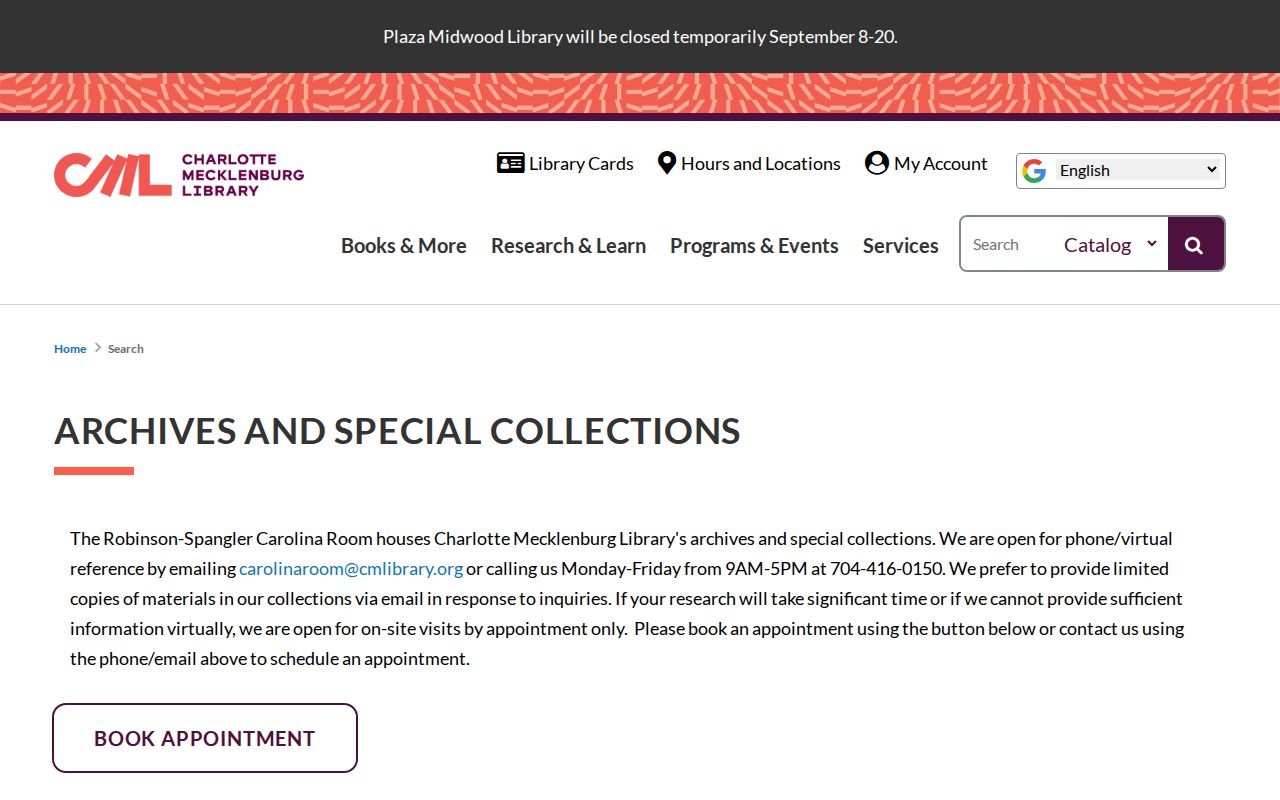
The archive route is useful because the directory shelf sits beside newspapers, maps, and other material needed to check a dated listing.
Mecklenburg County Directory Access
The Carolina Room offers an on-site, appointment-based service route and limited copying by email. Research notes list carolinaroom@cmlibrary.org and 704-416-0150, generally Monday through Friday from 9 a.m. to 5 p.m.; confirm the current appointment requirement before visiting. A focused question is especially important because the library policy sets limits on staff research time. Ask about a named volume, a page range, a former address, or a particular newspaper issue instead of requesting a broad surname compilation.
The library reference and research policy describes a specific-question model. It lists $15 per half hour, a $15 deposit, a two-hour or $60 cap, 30 minutes free for Mecklenburg County residents, and included first 20 photocopies. Reply may come by fax, standard mail, or email. Those figures describe the policy noted in the research, so confirm them with the library when making a request.
The reference-policy page shows the service framework used for city directory questions.
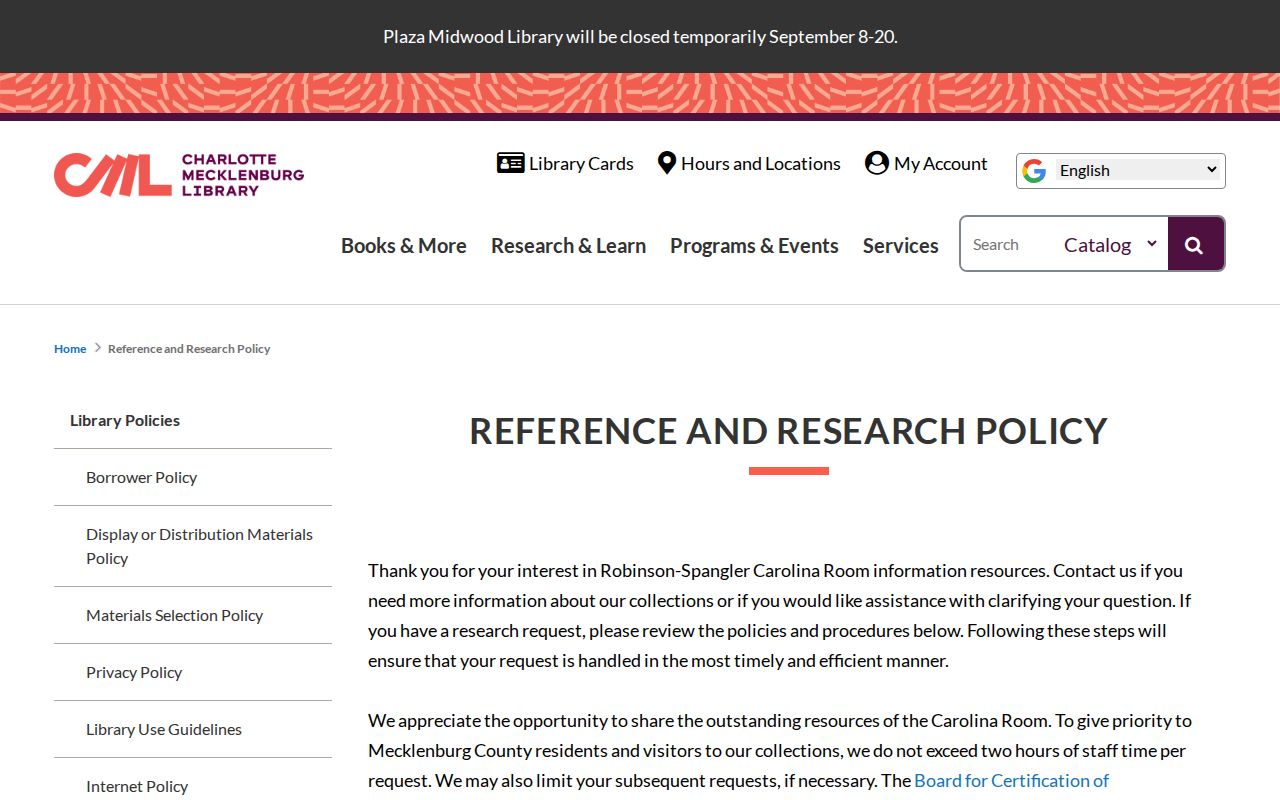
A narrow request lets staff identify the right shelf, microfilm run, or digital item without treating a library collection as a complete resident list.
Note: Request an edition, surname spelling, location, and desired copy format so staff can match the question to a real record.
Reading a Mecklenburg County Directory
A digitized Charlotte directory page shows the entry grammar that makes these books valuable: a printed surname and given name, occupation or employer, a residence or business address, and abbreviations for boarding, lodging, or a business connection. Transcribe exactly what appears, then make a separate search note for alternate spelling or initials. A business line can establish a local institution or work address without locating a home.
| Printed name | Keep the surname, initials, suffixes, and spelling as published. |
|---|---|
| Work line | Occupation, employer, or affiliation may distinguish two people with the same name. |
| Place line | Label a residence and a business address separately rather than merging them. |
| Household clue | A boarding or lodging abbreviation can describe an arrangement, not a proven family relationship. |
| Edition evidence | Record the year, page, scan URL, and a short confidence note. |
- Criss-cross directory
- A directory arranged by street address rather than surname. The Carolina Room should confirm whether a requested year has one.
- Householder index
- An index intended to point from a household name to a listing. Its exact scope depends on the edition.
- Abbreviation key
- The volume's own explanation of shortened terms. Photograph or record it before expanding an entry.
The historical Charlotte directory scan illustrates the entry structure.
The scan is a useful reading aid, but the visible page must still be cited by its own edition and page rather than by a partial OCR result.
Mecklenburg County Directory Scans
Charlotte Mecklenburg Story is now a migration issue as well as a research source. The library notice dated August 7, 2026 said the former platform would shut down August 10 and direct visitors to The Vault, archival finding aids, and selected Internet Archive captures. Treat an older CMStory directory link as archive-dependent. Preserve the older URL, the capture date, the scan or item identifier, and the original publisher whenever possible.
The Charlotte Mecklenburg Story notice is the starting point for that migration context.
Following the library's migration route helps distinguish a live library collection from a preserved legacy exhibit or a historical PDF.
The Carolina Room received $153,644 in December 2024 board minutes for digitization equipment. That investment is a reason to recheck the Vault for newly available scans, not a promise that any particular directory volume has been digitized.
Mecklenburg County Directory Context
City directories work best beside records that answer a different question. The library's Charlotte Observer holdings support searches by name, keyword, or phrase and are described as spanning 1888 to today for library-card remote access, while the archives collection page also lists microfilm and print runs with uneven coverage. A newspaper notice can help date a move, death, business opening, or civic event, but its issue and page should be recorded and its statements checked against another source.
The Mecklenburg Historical Society offers county-history context and referrals through its affiliate network, including the Olde Mecklenburg Genealogical Society. Its inspected public pages do not publish a complete searchable holdings list, research hours, or fee schedule. Use it as a context and referral source, not as a guaranteed directory catalog.
The Historical Society page provides the context route for Mecklenburg County directory research.
Historical context can explain a street or institution, while a dated directory page remains the evidence for a printed listing.
A city directory entry can also be paired with the August 1900 Charlotte Sanborn map set, which has 25 public-domain sheets. The map can show a building footprint, street intersection, or land use at that date, but it cannot identify an occupant from the outline alone.
Mecklenburg County Directory Language Changed
Older Charlotte city directories require source criticism. A library exhibit documents separate listings for Black residents before 1910, an asterisk in integrated entries from 1910 to 1930, a “c” notation from 1930 to 1951, and no race designation after 1951. Those marks reflect the publication's editorial practice. They should be described only when necessary for historical interpretation and must never be turned into a present-day identity claim.
The same exhibit notes a first automobile listing in 1904 and more than 150 grocers, bakers, and butchers in early directory material. These details support a narrow neighborhood-economy question, such as comparing commercial entries with a dated Sanborn sheet. They do not establish that a person lived in a particular building.
Note: Preserve historical wording only when essential to identifying the source's editorial system, and avoid copying outdated labels into current descriptions.
Trace a Mecklenburg County Directory Household
Start with one dated directory entry and trace it outward, not with a conclusion about a household. The practical chain is printed name and address, nearby directory edition, accessible census schedule when relevant, newspaper or obituary lead, then a deed, probate, or other custodian record if the question requires it. For a current parcel question, use the Mecklenburg County street directory record trail instead.
- Find the first confirmed edition and copy its exact name, address, occupation, and page number.
- Check the preceding and following available editions for a move, changed initials, business line, or disappearance.
- Compare an applicable census schedule or another dated institutional record, keeping the source roles separate.
- Search the library's newspaper holdings for a date-specific notice, then save the issue and page.
- Use a deed, estate file, or archive item only to support the narrow fact that source actually records.
A disappearance can mean a move, death, unlisted status, a changed spelling, or a gap in the collection. The correct result is often “not found in the examined editions,” followed by the next custodian route, not a claim that the person left Mecklenburg County.
Mecklenburg County Directory Gaps and Backstops
The documented city directory run ends in 1989, while the county's modern land-record route begins in March 1990. For a question that crosses that change, use the historical Register of Deeds index for 1763 through February 1990 and the modern index for March 1990 forward. The Register of Deeds real-estate records page describes both routes. A deed records a legal instrument or party role, not necessarily a resident.
For deeper historical gaps, the North Carolina State Archives copy-request form accepts a specific county, year, name, and record series request. Its listed choices include wills, estates, deeds, court minutes, maps, cemetery surveys, marriage material, and land grants. That is a targeted alternative when a library scan or annual volume does not answer the question.
The Charlotte City Clerk page is another route for existing municipal minutes, ordinances, resolutions, boards, commissions, and government-history material.
Municipal records can document a place or institutional decision, while directory research should retain its own edition, page, and access-date evidence.